
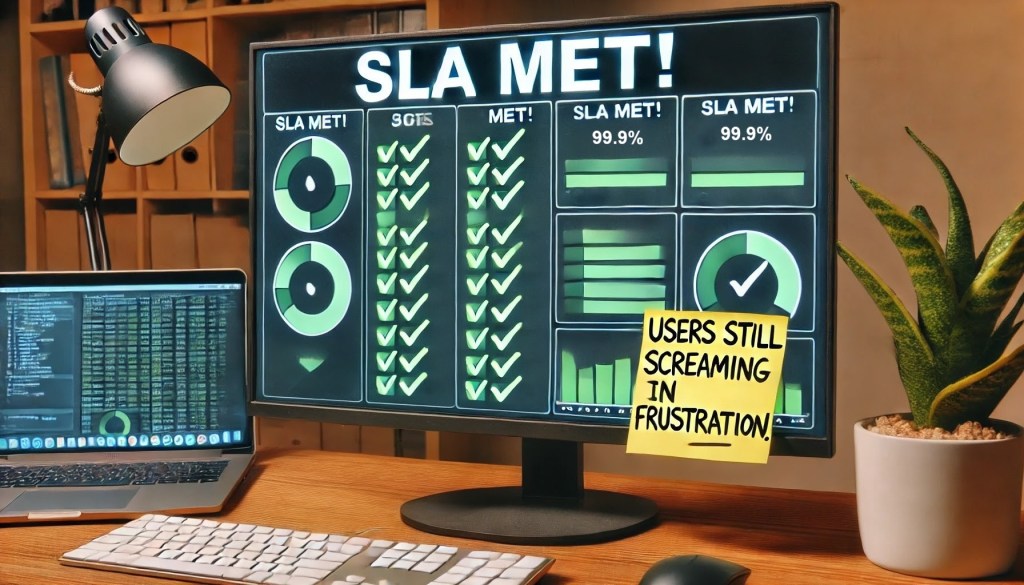
To be honest, SLAs are important. No doubt! They make IT meet their committed goals and feel accomplished. But should SLAs be only measure to the IT services?
Think about below real-life situation you must have experienced somewhere during your journey-
-SLA achieved 99.9% uptime. Except, the 0.1% downtime happened exactly when the finance team was finalizing the quarterly revenue report!
-Response time was within SLA! Except, the user spent 25 minutes convincing IT support that “no, my problem is not because I need to restart my laptop.”
-Issue resolved in 4 hours complying to the SLA. Except, the user lost an entire sales deal because they could not access the system at the right moment.
SLAs measure IT’s success and users/service consumers measure IT’s impact.
So basically, SLAs are not the villain. They just are not the whole story.
SLAs are absolutely elemental and helps define and measure the baseline for the IT services’ deliverables. They keep us accountable. But if IT only focuses on “Did we meet the SLA?” instead of “Did we actually help the business?”, then we are solving for the wrong outcome OR half the outcome of the IT service.
Experience matters. The IT service consumers definitely least care that IT followed process OR met the SLA. They care whether IT was there when it counted.
Along with celebrating the SLA compliance, it is also worth tracking Business impact of downtime (not just % uptime), Critical event protection (Black Friday/Sales days, finance period-end closures, CEO town halls etc), Proactive service experience monitoring (because as I wrote above, users do not care about SLA dashboards. They care about when things do not work for them).
PS – SLA compliance is fundamental, but have you tried actual user satisfaction? Spoiler: It is way harder to achieve. 😉

 Decoded: IT Stories That Matter.
Leave a comment