
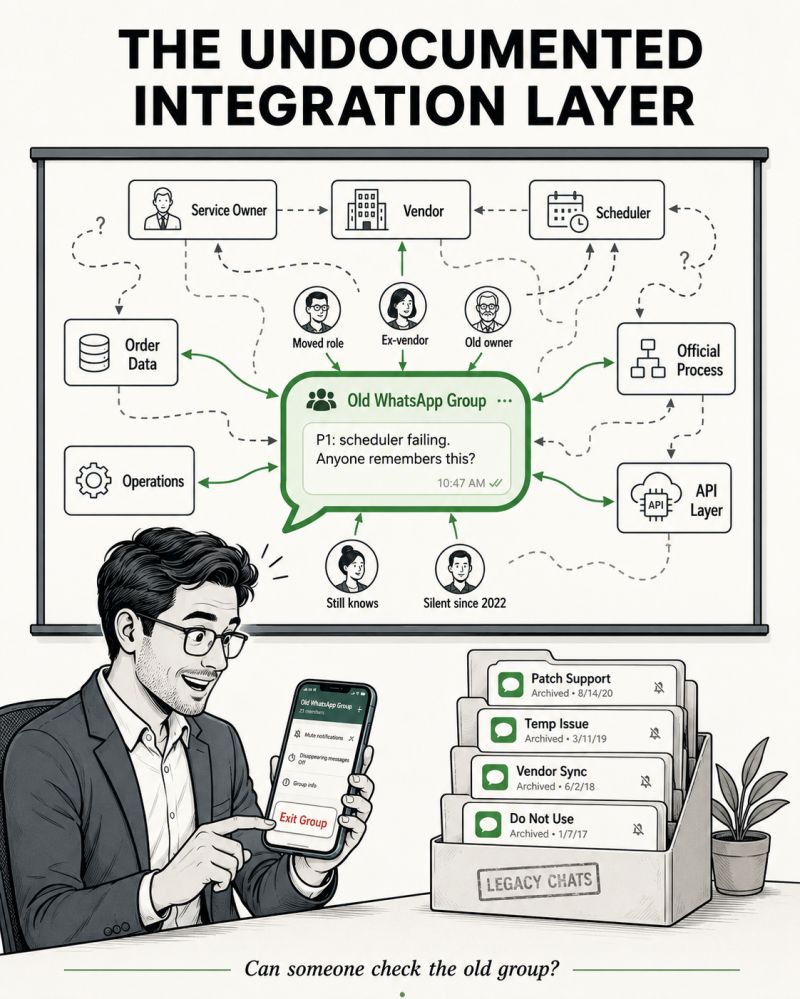
A message popped up in a WhatsApp group on my phone yesterday. For a moment I had to to sift through my memory to recall this group.
Anyways, the group had been created long back during one of those messy service issues and some 40 folks in it. The original issue had been closed years ago. By now few folks have changed roles, changed organizations, and I also moved on!! But the group was still there, sitting quietly like an unpaid support contract.
Exactly the message reads – “We have P1. xyxy job scheduler is failing (𝘐 𝘩𝘢𝘷𝘦 𝘵𝘰 𝘴𝘵𝘪𝘭𝘭 𝘩𝘪𝘥𝘦 𝘵𝘩𝘦 𝘯𝘢𝘮𝘦 𝘩𝘦𝘳𝘦). Order data is not moving downstream in staging tables.”
Just one message rejuvenated this WhatsApp group!! Suddenly people who had not spoken there for ages started appearing. Someone remembered the vendor contact. Someone remembered the batch timing. Someone remembered who had handled something similar in past.
At first I smiled. There is something funny about an old group suddenly becoming useful again. But the next thought was less funny. Why was this the place people came back to? Why was internal detail still sitting in a WhatsApp group with people who had moved roles, moved teams, and maybe even moved organisations? And why could this group find context faster than the official route?
I am not against these groups. Many times they save the day. But if the service needs years older WhatsApp group to find its own owner, maybe the group was never temporary!!
Maybe it was the architecture diagram nobody wanted to draw!! Because apparently API was not the real integration layer. It was perhaps “can someone check the old WhatsApp group?” 😉
P.S. I exited the group after this. Then spent the next few minutes scrolling through WhatsApp to check how many other “operating models” I am still unknowingly part of. How many such old operating models are still sitting quietly in your WhatsApp?


Leave a comment